An Introduction to Astronomical Photometry Using CCDs Guid PDF Free Download

Photometry: What and Why
Many people are interested in astronomy because it is visually exciting. The many marvelous
pictures of celestial objects taken using large telescopes on the ground or in space are certainly the
most visible manifestation of modern research astronomy. However, to do real science, one needs
far more than pictures. Pictures are needed as a first step in classifying objects based on their
appearance (morphology). To proceed past this initial stage of investigation, we need quantitative
information- i.e. measurements of the properties of the objects. Observational astronomy becomes
science only when we can start to answer questions quantitatively: How far away is that object?
How much energy does it emit? How hot is it?
The most fundamental information we can measure about celestial objects past our solar system
is the amount of energy, in the form of electromagnetic radiation, that we receive from that object.
This quantity we will call the flux. The science of measuring the flux we receive from celestial
objects is called photometry. As we will see, photometry usually refers to measurements of flux
over broad wavelength bands of radiation. Measurement of flux, when coupled with some estimate
of the distance to an object, can give us information on the total energy output of the object (its
luminosity), the object’s temperature, and the object’s size and other physical properties.
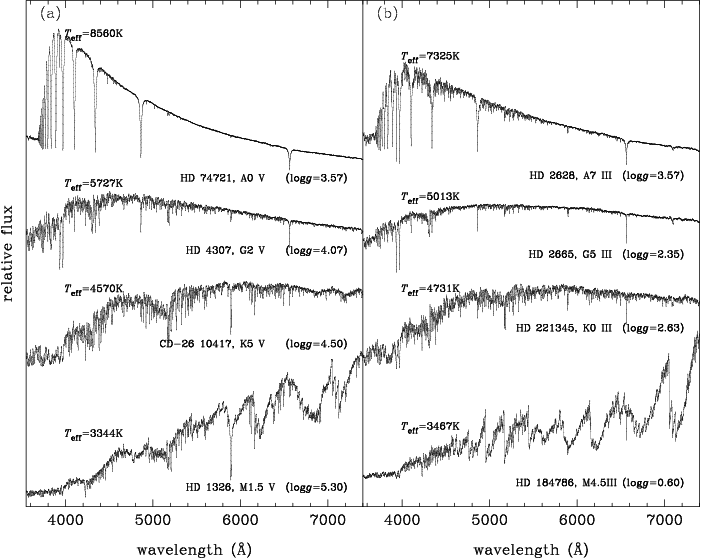
If we can measure the flux in small wavelength intervals, we start to see that the flux is often
quite irregular on small wavelength scales. This is due to the interaction of light with the atoms
and molecules in the object. These “bumps and wiggles” in the flux as a function of wavelength
are like fingerprints. They can tell us lots about the object– what it is made of, how the object is
moving and rotating, the pressure and ionization of the material in the object, etc. The observation
of these bumps and wiggles is called spectroscopy. A combination of spectroscopy, meaning good
wavelength resolution, and photometry, meaning good flux calibration, is called spectrophotometry. Obviously, there is more information in a spectrophotometric scan of an object compared with
photometry spanning the same wavelength range. Why would one do low wavelength resolution
photometry rather than higher resolution spectrophotometry or spectroscopy, given the fact that a
spectrum gives much more information than photometry? As we will see, it is much easier to make
photometric observations of faint objects than it is to make spectroscopic observations of the same
object. With any given telescope, one can always do photometry of much fainter objects than one
can do spectroscopy of. On a practical note, the equipment required for CCD imaging photometry
To Be Count.. Download this Books Dear thanks and keep smiling...
Download Here

Comments

Popular posts from this blog

Chrysler Deletes Its Dating Apps, Decides To Remain Single For Now

They say you can’t have a healthy relationship until you’re happy with yourself. That appears to be the new mantra for Fiat Chrysler: After several attempts to woo General Motors and more recently Volkswagen , the carmaker’s top executive says he plans to ditch his lovelorn ways to concentrate on his company’s bottom line.  Bloomberg reports that CEO Sergio Marchionne has turned his focus to eliminating FCA’s debt rather than eliminating its single status. Marchionne has set a goal of erasing FCA’s debt by 2019, the same year he’s set to retire. To do that, he says the company needs to do a little work on itself. “We need to be very careful that we don’t start unrealistic dreams about consolidation as we are on our way to achieve historically important results and a debt-free position,” Marchionne told investors at the carmaker’s annual meeting in Amsterdam, as reported by Bloomberg. “We are not at a point of time to discuss any alliance.” Yes, you heard that right: The man w...

Study Claims 43% Of “Wild” Salmon In Stores & Restaurants Isn’t Wild At All

That wild salmon entrée calling to you from the menu at dinner might not be all it’s advertised. In fact a new study released Wednesday found evidence of mislabeling in nearly half of all salmon sold in restaurants and grocery stores.  The study [ PDF ] from international environmental advocacy group, Oceana, analyzed 82 salmon samples from restaurants and grocery stores, finding that 43% of the products were mislabeled. DNA testing confirmed that 69% of the mislabeled product consisted of farmed Atlantic salmon being sold as wild-caught product. According to the report, consumers satisfying their salmon craving in restaurants are misled about 67% of the time, while those who buy their seafood in a grocery store are misled 20% of the time. “Americans might love salmon, but as our study reveals, they may be falling victim to a bait and switch,” Beth Lowell, senior campaign director at Oceana, said . “When consumers opt for wild-caught U.S. salmon, they don’t expect to get a far...

Introduction to Biology (IX Biology Notes Chapter 01)

Science: Our universe operates under certain principles. For understanding of these principles, the experiments are done and observations are made; on the basis of which logical conclusions are drawn. Such a study is called "Science". In brief science is the knowledge based on experiments and observations. Biology: The Scientific study of living organisms is called Biology. The word biology is derived from two Greek words "bios" meaning life and "logos" meaning thought, discourse, reasoning or study. It means that all aspects of life and every type of living organism are discussed in biology. Branches of Biology: Biology is divided into following branches: Morphology The study of form and structure of living organisms is called morphology. It can be further divided into following two parts: 1. The study of external parts of living organism is called external morphology. 2. The study of internal parts of living organism is calle...